
Now what?
"The meaning is in the waiting"
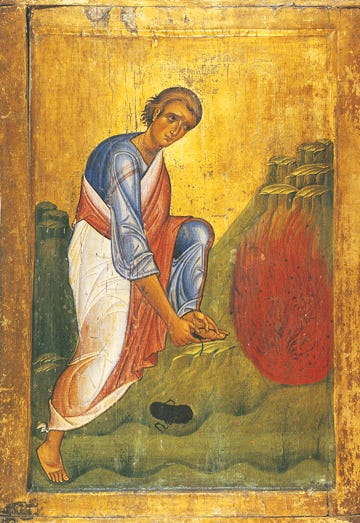
In the Church calendar, we’re in Ascensiontide, a season of absence, loss, and waiting. The story of the Ascension happens in the first verses of the Book of Acts: “Jesus was taken up before their very eyes, and a cloud hid him from their sight.” It’s the story of a feeling everyone knows well.
“Now what?”
The time of resurrection appearances, when people were having strange experiences of the Divine among them—in a garden outside the empty tomb, in a room behind locked doors, on the road to Emmaus, while they were at work (fishing)—that time must have been electric. As they told each other about their strange experiences of the Divine, we can imagine people in that time waking each day with a sense of excitement. “I wonder where I might experience this Presence today?”
The world and daily life, in Hopkins’ words, must have seemed “charged with the grandeur of God.”
But the wisdom of the liturgical calendar reminds us that, as exciting as the spiritual life can be, exhilaration never lasts. There are always times of emptiness and darkness, times of absence and waiting that can be unsettling. And if they go on too long, anxiety sets in.
That’s when we reach for the phone.
Instagram, Wordle, Spelling Bee, texts, email, Candy Crush…, or sometimes an app like Headspace or Calm with a curated meditation—anything but emptiness and waiting.
R.S. Thomas’s poem “Kneeling” concludes with a line that has haunted me lately. “The meaning is in the waiting.” The line haunts me because I tend to think of waiting as a prelude to something that is coming later. But the poem says the meaning is in the waiting, not after the waiting.
If the meaning is in the waiting, then maybe our tendency to distract ourselves in such times is worth noting but not acting upon. Because noticing our discomfort might lead us to pause long enough to ponder some of the most intriguing sayings of saints, poets, mystics, and Jesus himself.
In a time of dictatorship and brutality, Jesus said, “The Kingdom of God is among you now.”
In a time of terrifying plague and war, Julian of Norwich said, “All shall be well…”.
Amid recurring racial violence, Martin Luther King Jr. asserted, “The arc of the moral universe is long, but it bends towards justice.”
And anyone who has been around me long enough can quote the Archbishop of Canterbury, Rowan Williams, by heart. In an Easter homily years ago, Williams said,
“There is a deeper level of reality, a world within the world, where love and reconciliation are ceaselessly at work, a world with which contact can be made so that we are able to live honestly and courageously with the challenges constantly thrown at us.”
Beneath or behind the world of the obvious—grief, anger, violence, loneliness, and isolation—a subtler, quieter, but much stronger Presence is still at work. But it’s as if “a cloud hides him from our sight.”
If we are solely attuned to the obvious in the exterior world (especially to the wearying world of modern politics, divisive discourse, and coarsening culture), if our focus remains there, our God-given capacity to intuit a deeper level of reality can begin to atrophy. We have eyes but cannot see, ears but cannot hear. And the result is that the challenges thrown our way bring fatigue not courage.
But “turning aside like Moses” and attuning ourselves to a deeper level of reality is what contemplative practice is all about. Centering prayer, the quiet recitation of a psalm, a meditative walk, or simply the practice of silence with mindful breathing and smiling, these are calming because we are waking to something our souls have known all along—there is More. These practices bring peace, because they invite our letting go of our preoccupations with self and our spiraling mental chatter, so that we come home to the More of our lives.
And we sense that this “More” has been beckoning us. Our true life is a life of participation, participation in the deeper world of “ceaseless love and reconciliation.” And this true life is not something we do, as much as it is something that is done through us. It courses through our veins the way sap from the vine flows through its branches. (John 15:5) The Divine seems to say, “My power, my life, my joy, my peace … these are strongest in your weakness, your emptiness, your letting go.” (see 2 Cor. 12:9)
But as James Finely says, “That which is essential never imposes itself. That which is inessential is constantly imposing itself.” This life of joy and peace is always there, but in our noisy, blustery, and over-busy culture, rarely noticed. It is the still, small voice in the midst of powerful earthquakes, shattering winds, and consuming fire. By comparison, our true life is “the sound of shear silence.”
A favorite poem by Annie Lighthart embodies the life-giving and life-affirming calm of waking to the depths of the world and of our own souls:
The Second Music

Now I understand that there are two melodies playing,
one below the other, one easier to hear, the other

lower, steady, perhaps more faithful for being less heard
yet always present.

When all other things seem lively and real,
this one fades. Yet the notes of it

touch as gently as fingertips, as the sound
of the names laid over each child at birth.

I want to stay in that music without striving or cover.
If the truth of our lives is what it is playing,

the telling is so soft
that this mortal time, this irrevocable change,

becomes beautiful. I stop and stop again
to hear the second music.

I hear the children in the yard, a train, then birds.
All this is in it and will be gone. I set my ear to it as I would to a heart.

~ Annie Lighthart, from Iron String © Airlie Press, 2015
“The meaning is in the waiting.” It’s not coming later, in a better time. It is now. As the Psalmist says, “Be still and know that I am God.” (46:11)
Beautiful and joyful photo! ❤️
Thank you, Gary.
"The waiting is the hardest part" Tom Petty. Thank you Gary.